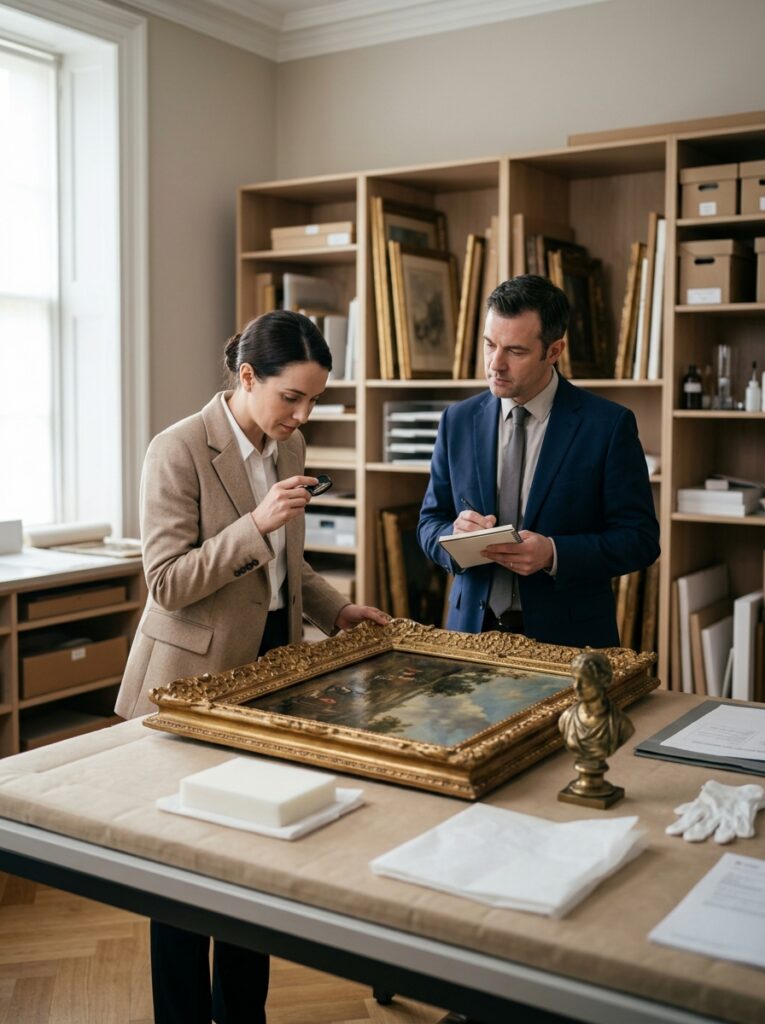
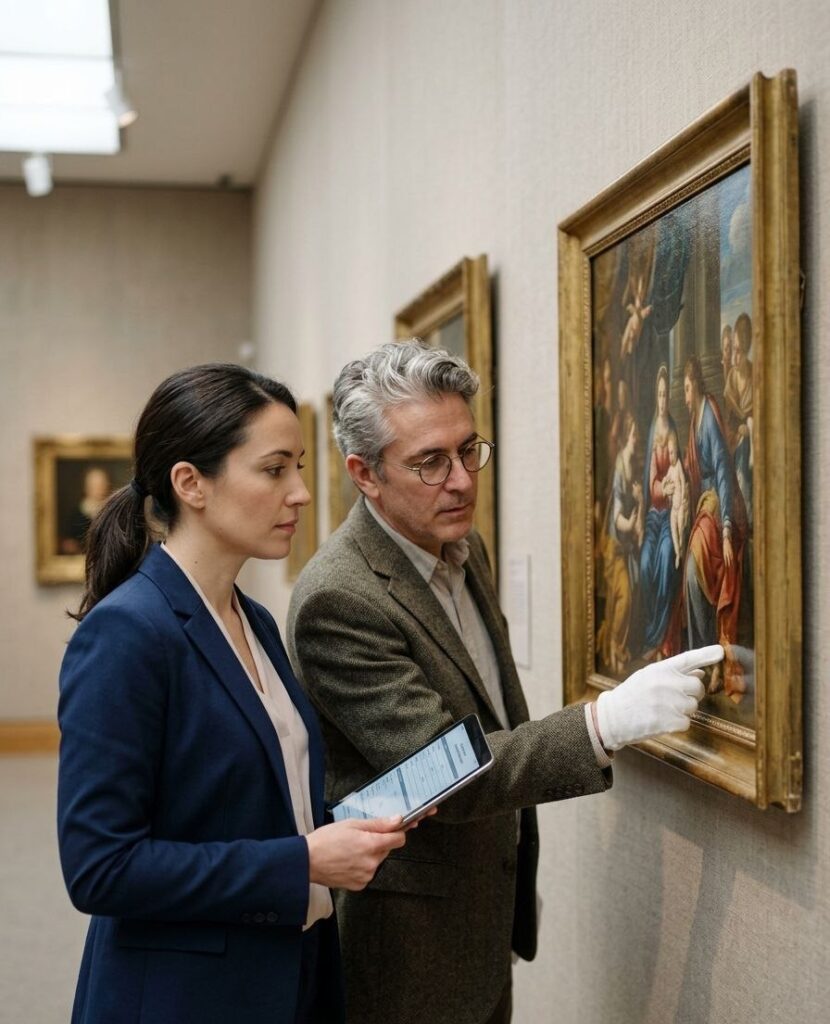

When you consign a painting, icon, print, or other artwork for temporary or long-term storage, one question almost always arises: what value should be stated in the storage agreement and insurance policy? This is relevant not only for private collectors but also for heirs, galleries, museums, and exhibition projects—anywhere accountability, condition documentation, and transparent terms matter.
Below is a practical guide on how to calculate insured value and mitigate risks when storing artworks. If you are looking for a depository with museum-level handling standards and clear protocols, please visit our Storage / Depository page.
The first thought when consigning an item for storage is often: «How much is this worth, and what amount should I declare?» The correct insured value is not a formality—it is your protection tool in case of an incident: flood, fire, theft, damage during handling, packaging errors, or installation mistakes.
The main risk is not only the event itself, but disputes over the amount. If the value is overstated or understated, a stressful situation turns into lost time: expert assessments begin, correspondence with the insurer intensifies, and the item’s condition and documentation must be clarified «as of the date of transfer.»
When determining insured value for storage or transportation, owners typically choose one of two approaches:
Both options are viable, but they differ in risk level during claims settlement.
A professional appraisal addresses two key objectives:
For insurance purposes, this is critical: the clearer the basis for valuation, the smoother the claims process.
Depending on the type of artwork, this may include specialized institutions and conservation centers, independent appraisers and art experts, or specialists in specific fields (icons, works on paper, sculpture, contemporary art, etc.).
If items are already prepared for transfer to a depository, it is safer to organize the process to minimize handling:
This reduces the risk of damage and simplifies documentation. For details on acceptance procedures and storage terms, please refer to our dedicated page.
Sometimes circumstances are urgent: relocation, renovation, inheritance, or exhibition preparation. In such cases, the owner declares a value based on available documents and market research.
It is important to understand the risk logic:
Therefore, self-assessment should never be a guess—it must be grounded in verifiable sources.
The most reliable foundation is legal documentation:
Even if the purchase was made long ago, this serves as a solid starting point. Best practice: keep copies of all documents together with the storage agreement and acceptance report—this simplifies insurance-related inquiries.
For established artists, auction results and publications from specialized resources provide valuable benchmarks. For lesser-known artists, a «value range» is often established based on comparable works, adjusted for condition, dimensions, technique, and documented provenance.
Condition directly affects insured value. Therefore, the key document is a thorough condition report at the time of transfer for storage or prior to transportation.
For art storage, it is essential to have a clear «baseline»: exactly what you are consigning and in what condition.
A minimal set that significantly simplifies claims settlement includes:
This is especially important for exhibition projects involving multiple handovers: owner → transporter → venue → return.
The art market evolves. Therefore, for long-term storage, it is advisable to periodically review the insured amount—particularly if the item has been exhibited, undergone conservation, or if demand for the artist has increased.
Simple rule: the insured amount should reflect current market conditions at the time of storage/transportation, not «as stated in an old agreement.»
Insured value is only half the protection. The other half is storage conditions and process integrity.
For storing artworks and private collections, the following are essential:
This is an integrated chain: documentation + conditions + process. Learn more about our depository services and acceptance procedures on the Storage / Depository page.
We assist private owners, heirs, galleries, and exhibition projects: we collect → professionally pack → transport → accept into storage (with condition report and photo documentation) → release upon request.
Submit a request — and we will propose a secure solution and cost estimate.
